▫️ Why a $2 Mining Stock and a Pre-IPO Unit Share One Hidden Mechanism
Junior miners, pre-IPO units, and leveraged funds all promise multiplier exposure. The structure hides the cost. Here is how it actually works.

▫️ THE CORE TOPIC
For most of investment history, owning an asset meant owning it directly. Buy the stock, hold the bond, take physical delivery of the metal. The price you paid was close to the price the market quoted. Friction was minimal.
That model has been packaged. Today, investors are offered access wrappers built around the underlying asset: junior mining stocks pitched as leveraged plays on gold, pre-IPO units sold by venture funds before listings like Starlink, leveraged ETFs that promise 2x or 3x daily returns. One newsletter currently markets a $2 gold mining stock projected to ten-bag once production begins.
The structural driver is gatekeeping. Direct exposure to attractive assets has become harder, slower, or simply unavailable to retail. The wrapper closes the gap. The wrapper also collects a fee at every layer.
▫️ THE MECHANISM
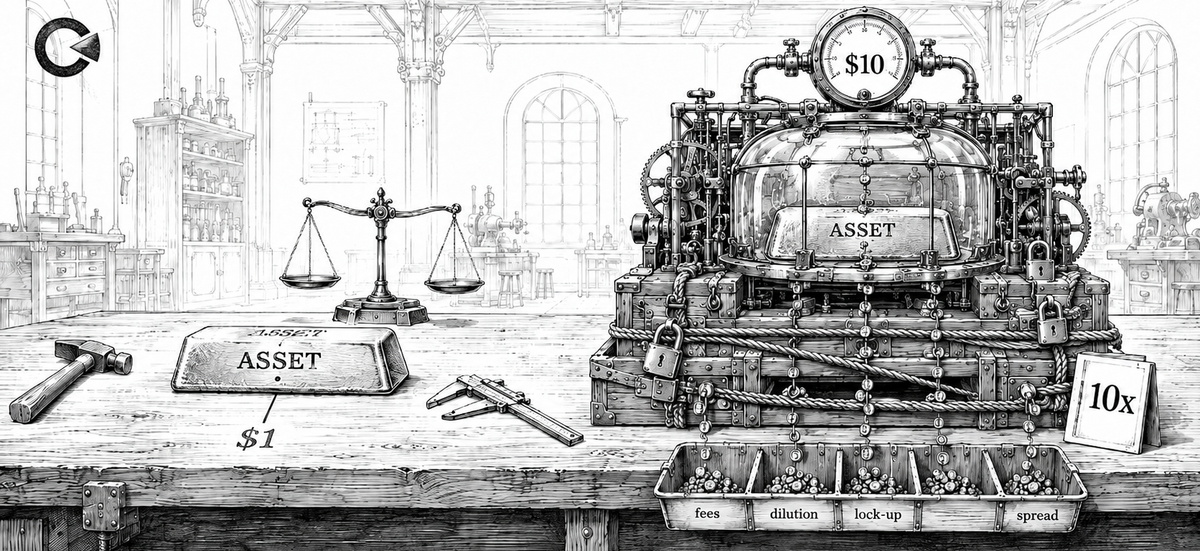
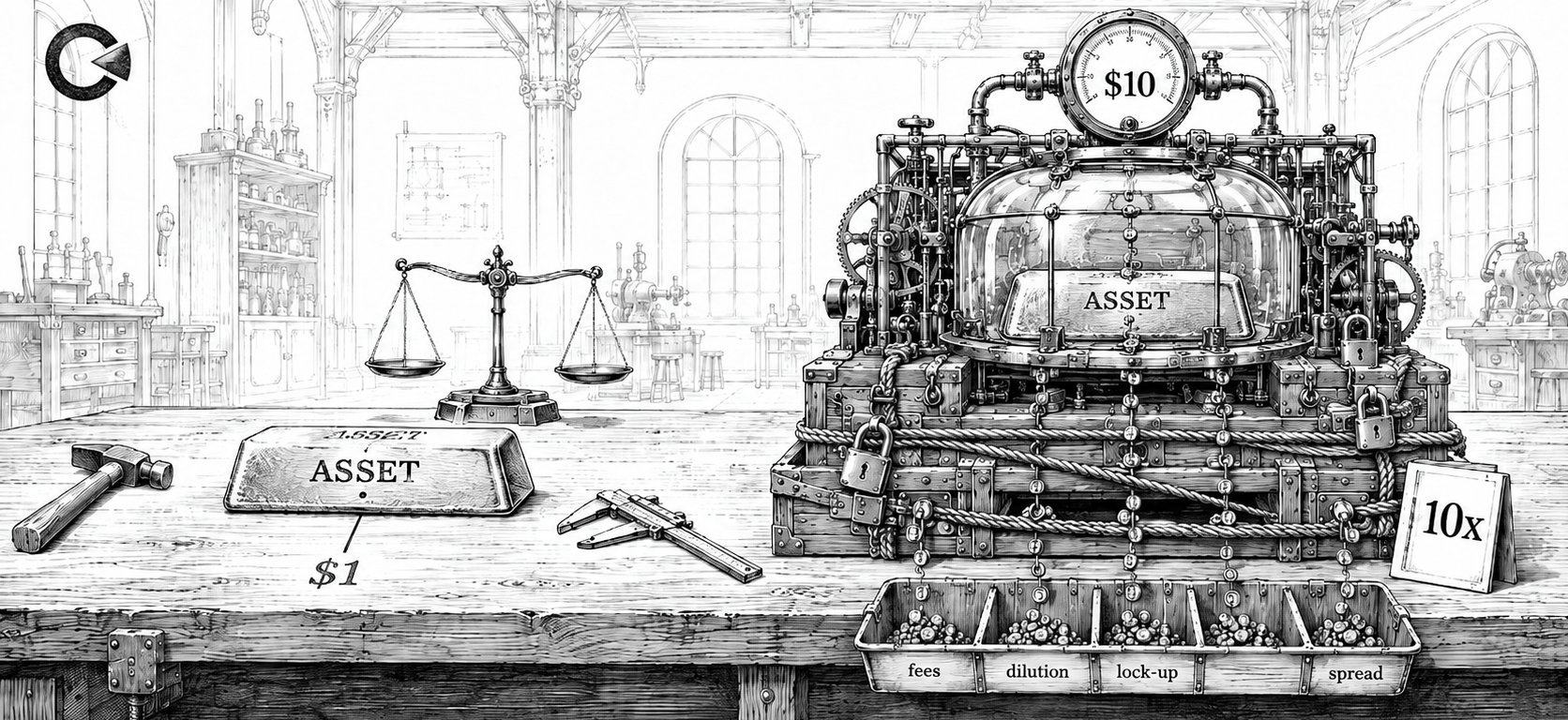
An access wrapper is not the same trade as the underlying asset. Four gears separate them.
- Operational risk lives in the wrapper. A gold miner can hit the same ore body as the price moves up and still lose money on costs, permits, or strikes. A pre-IPO unit can hold real shares but charge 2% per year.
- Promoter incentives reward distribution. Pitches for junior miners or pre-IPO units pay commissions on units sold, not on outcomes.
- Liquidity is the silent tax. Lock-ups, gates, and thin secondary markets mean the price you see is not the price you can exit at.
- Multiplier framing hides dilution. "10x potential" assumes the share count stays still. Most junior issuers raise capital repeatedly, shrinking the multiplier each round.
The wrapper is rarely the same trade as the asset.
▫️ THE CASE FILE
Consider WeWork in January 2019. A SoftBank Vision Fund round priced it at $47 billion, the high-water mark for the private unicorn era. Pre-IPO units were marketed at that level.
By August, WeWork filed for IPO. The S-1 showed a $1.9 billion loss on $1.8 billion revenue. By September 30, the offering was withdrawn. Adam Neumann stepped down. The valuation collapsed to roughly $10 billion in six weeks. A 2021 SPAC listing valued the company at $9 billion. Chapter 11 followed in November 2023.
Investors who bought access at $47 billion did not buy WeWork. They bought a wrapper.
▫️ THE PRESSURE TEST
The access-wrapper model is real, and so are its risks.
- Some wrappers do deliver. A well-managed junior with a discovered ore body has produced ten-baggers. Selecting them in advance is the hard part.
- Pre-IPO access can be legitimate. Reputable secondary markets exist with real share transfer and audited cap tables.
- Costs compound across the wrapper. Fees, dilution rounds, and lock-up discounts subtract from the multiplier the brochure shows.
- Liquidity matters more than headline upside. A 10x on paper that cannot be sold is not 10x.
These risks are real. But investors who measure the wrapper itself, not the underlying story, have positioned with clearer eyes and better risk-adjusted outcomes than those chasing the multiplier alone.
▫️ AUTHOR'S LENS
I have seen junior miners promise ten-bags my whole career. Some delivered. Most did not. The ones that did paid back a fraction of the dilution between the pitch and the production.I do not avoid access wrappers as a rule. I read them as separate trades from the asset they describe. Then I decide whether I want the asset, the wrapper, or neither.Build the structure. Ignore the noise. |  |
▫️ PAST ISSUES