▫️ The US Carries Over $1 Trillion of Metal on the Books at $11 Billion.
The gap between what the ledger says and what the vault holds is one of the largest in public finance.

▫️ THE CORE TOPIC
Accounting is supposed to describe reality. A balance sheet lists what is owned and what it is worth, and most people assume those figures track the world as it moves.
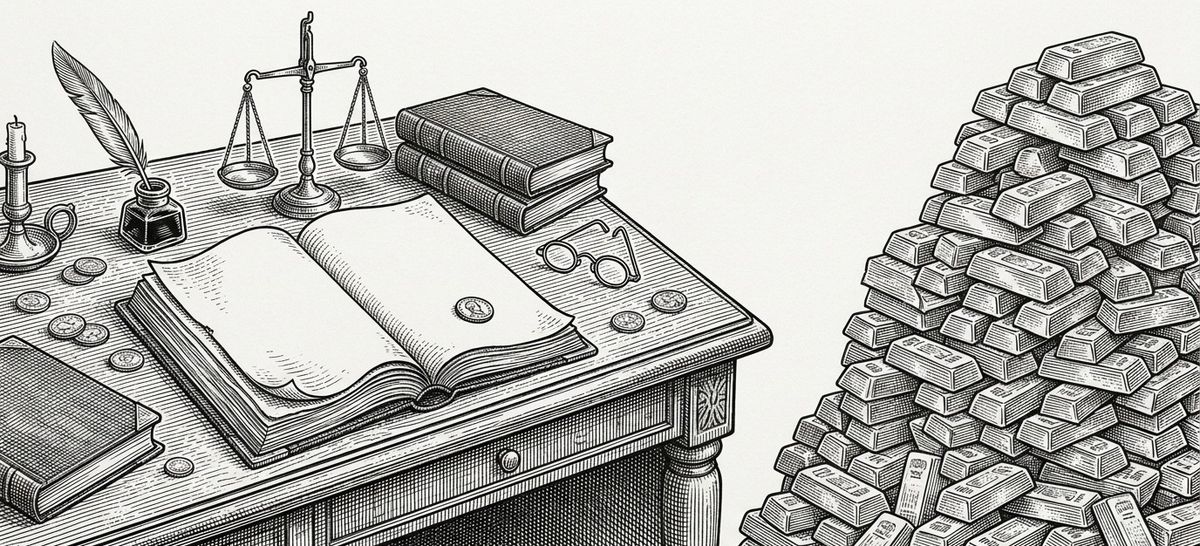
Some of the largest holdings on earth are recorded at prices from another era. The United States Treasury carries its gold at a statutory value of $42.22 an ounce, a number fixed by law in 1973 and never revised, while the metal itself trades above $4,000. Roughly 261 million ounces sit in the vaults either way. The same principle explains why an unremarkable regulatory filing or an unused licence can carry an enormous figure that appears nowhere in the accounts until somebody chooses to recognise it.
Nothing about the asset itself changes when a recorded price is finally updated. Only the paperwork does. Yet that single adjustment can transform how an entity looks to every person reading its accounts, and it can arrive without warning.
▫️ THE MECHANISM
The gap between recorded and real value opens through a few gears.
- Historic cost is the default. Accounting convention records an asset at what was paid, not what it is worth, so land, buildings and metal held for decades sit at figures nobody would accept today.
- Statutory prices freeze. When a value is fixed by legislation rather than by a market, it stays fixed until legislation changes, however far reality travels.
- Recognition is a decision, not an event. Someone must choose to revalue. Until that choice is made, the value exists in the world but not in the accounts.
- The gap creates political temptation. A large enough difference between book and market invites proposals to capture it, which is why talk of unlocking value in an existing hoard resurfaces whenever budgets tighten.
The asset was always there. What changes is the number written beside it.
▫️ THE CASE FILE
A revaluation on this scale has happened once in American history, in the depths of the Depression. Gold had been fixed at $20.67 an ounce for roughly a century, and the government held a great deal of it.
The Gold Reserve Act passed on 30 January 1934, and the official price was raised to $35 an ounce. No metal was mined, moved or purchased. One legislated number was changed.
Section 10 of the act then established a stabilization fund of $2 billion under Treasury control, drawn from the profit the government earned by raising the price. That fund still exists today, built entirely from the gap between an old recorded price and a new one.
▫️ THE PRESSURE TEST
- A revaluation creates no new wealth. Changing a recorded price adds accounting room, not ounces.
- Book value can be too high as well. Assets carried above what they would fetch are the commoner problem, and they hurt more.
- Timing is unknowable. A gap can persist for fifty years, so a stale recorded price is not a plan with a date attached.
- Recognition brings consequences. Marking a national hoard to market has monetary effects that serious people debate.
What survives all of this is the holding itself. An ounce in a vault does not consult the ledger to know what it is. That is the quality worth owning: value that exists whether or not the paperwork has caught up.
▫️ AUTHOR'S LENS
I learned early to read the notes at the back of a report rather than the headline figure at the front. That is where the real story usually sits, recorded at a price somebody set long ago and nobody has revisited.It taught me to prefer things whose worth does not depend on being written down correctly. Metal in a vault is indifferent to accounting policy. It has been indifferent through every rule change I have watched, and it will outlast the next one too.Build the structure. Ignore the noise. |  |
▫️ PAST ISSUES