The reactor near Middletown had no gauge for the only question that mattered.

 |  | Susan Price & Marcus Grant September 30, 2026 |
THE SHORT VERSION |
• A reactor near Middletown, Pennsylvania opened a valve in 1979. • The panel in the control room said it had shut. • It stayed open for two hours and twenty minutes. • Clearing up afterwards took fourteen years. |
THE SETUP |
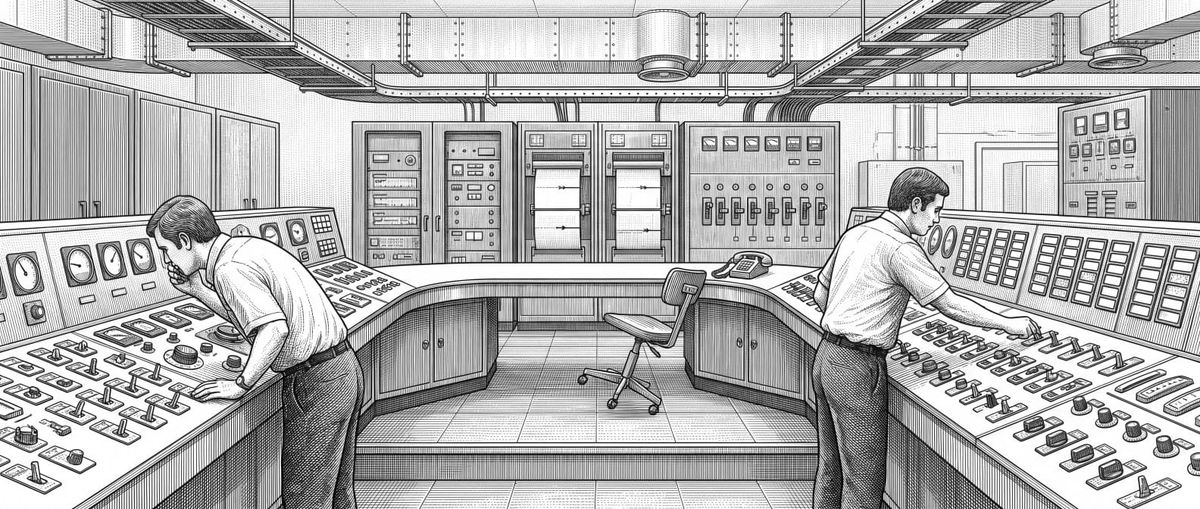
Three Mile Island sits in the Susquehanna River, three miles downriver from Middletown, Pennsylvania. Unit 2 was newly licensed. At about four in the morning on Wednesday, March 28, 1979, the pumps sending water to the steam generators stopped. The turbine shut down, the reactor shut down behind it, and pressure on the nuclear side began to climb. A relief valve on top of the pressuriser opened to let that pressure off, which is what it is there for. When the pressure came down the valve was supposed to close. It did not. The panel showed it closed anyway, because the indicator was wired to the signal sent to the valve and not to the valve itself. Steam went out through it at a rate equivalent to about 220 gallons of water a minute, down into the basement of the building, for more than two hours. Nobody in the room knew the coolant was leaving. |
THE TIMELINE |
Every row below comes from one document, the knowledge management digest that the Nuclear Regulatory Commission keeps on the accident, NUREG/KM-0001, first issued in 2012 and revised in June 2016. The agency's research office assembled it to hold in one place what the NRC learned, and it carries both the plant's own week and the years that followed it. Read the second row first. The two auxiliary feedwater trains that should have taken over were valved shut, and a paper tag hung on the panel covered one of the two lights that would have said so. The delay came to eight minutes. The inquiry later concluded those eight minutes did not change the outcome, because the relief valve was open the whole time. |
THE BREAK |
The room was not short of information. It was short of information about the four things that mattered. • The light reported the order. The indicator was wired to the signal sent to the valve rather than to its position, so it read closed while steam went out through it for two hours. • No gauge for the question. The vessel holding the core is full to the top in normal running, so nobody had built an instrument to say whether the core was covered. The crew read the pressuriser level instead. • The inference ran backwards. On April 5 the regulator wrote that the pressuriser reading had apparently led the operators to end high pressure injection early, while substantial voids sat in the coolant system. • The pumps were turned off. The coolant pumps began to vibrate as pressure fell and were turned off before they shook apart. With nothing circulating and the injection cut back, the level fell and the core overheated. |

WHO PAID |
Nobody died and nobody was hurt. About 2,000,000 people lived around the plant, and the regulator puts their average dose at roughly one millirem above the background they get anyway, which runs 100 to 125 millirem a year. A chest X-ray is six. The bill was settled elsewhere. On the Friday the governor asked everyone inside five miles to stay indoors and pregnant women and preschool children to go; the advisory stood two weeks. The regulator sent its first bulletin to the Babcock and Wilcox plants four days in, and the action plan that grew out of it ran to about 371 requirements and 13,863 items once matched against plants. The core stayed where it was. The head came off in 1985, the last fuel left in 1990, and the building went into monitored storage in December 1993. |
THE PATTERN |
• Ask what it is attached to. A reading can report the command sent rather than what was meant to happen, and the two look identical on a panel. • The missing gauge matters. Nobody builds an instrument for a condition assumed never to arise, which is the one somebody will need to read. • A label can be load-bearing. A paper tag over one light is not small when that light alone says a valve is shut. • Two clocks run in every room. Two hours and twenty minutes; what they left took fourteen years, and only the first number gets reported. I worked a desk in 1987 where the quote machine and the floor disagreed for twenty minutes, and the machine was what everyone acted on. When a reading matters, ask what it is physically attached to: gold on a scale is attached to the gold, most readings to a signal about something else. |