The government engineer who refused to sign off on the bridge was removed instead.

 |
 |
Susan Price & Marcus Grant September 25, 2026 |
THE SHORT VERSION |
|
• A two-lane crossing built to a figure set in Washington. • The design came down from $11,000,000 to $7,000,000. • It stood four months and one week. • The piers still carry the crossing built in 1950. |
THE SETUP |
|
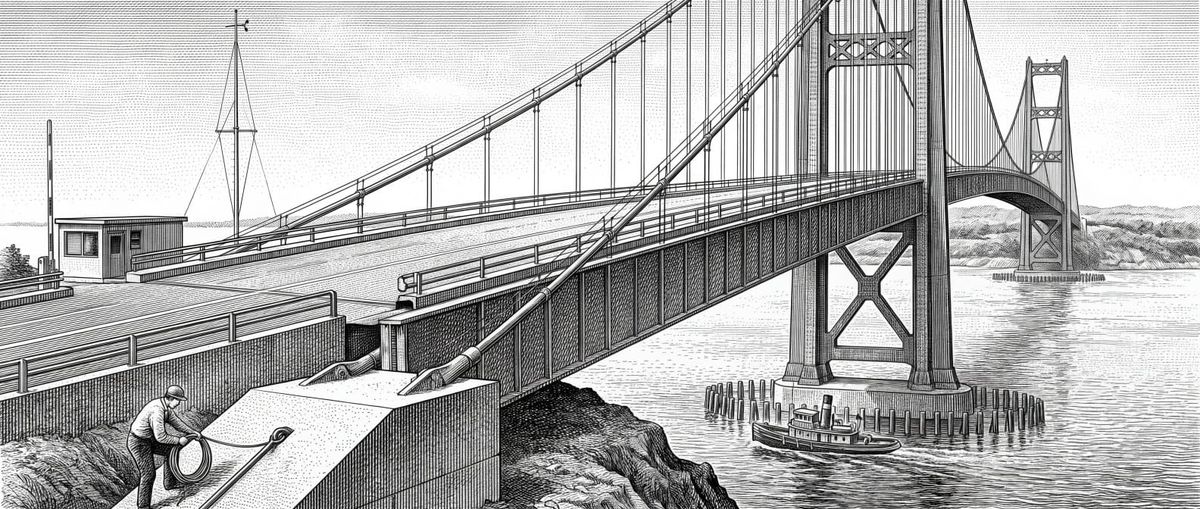
In the spring of 1938 the Washington State Highway Department had a finished layout for a crossing at the Tacoma Narrows. Clark Eldridge, its engineer on the project, had drawn a two-lane suspension bridge with stiffening trusses 25 feet deep and a centre span of 2,600 feet. The state did not have the whole figure. The Public Works Administration agreed to cover 45 percent of construction on one condition: an outside consultant for the superstructure. That consultant was Leon Moisseiff of New York, who had brought deflection theory into American suspension bridges in 1909. He told the PWA his revisions would bring the estimate down from $11,000,000 to $7,000,000. Nothing was hidden. The 25-foot truss became a solid plate girder 8 feet deep, the centre span grew to 2,800 feet, and the bracing struts were cut to two above the deck and two below. Every number sat inside the accepted theory, and the span that opened on July 1, 1940 was the third longest in the world. |
THE TIMELINE |
|
Every stage below comes from one document, the state chronology of the crossing, assembled from the Toll Bridge Authority records, the construction contracts and the department files. It runs from the first soundings in 1928 to the removal of the tolls in 1965. Read the September 1940 row. Two months after the opening, the Toll Bridge Authority commissioned a wind tunnel model at the University of Washington to find out why the deck moved. That is the stage that could not be taken back, and not because the study was wrong. From that row on, the state was studying a structure it had already accepted, opened and put under traffic. |
THE BREAK |
|
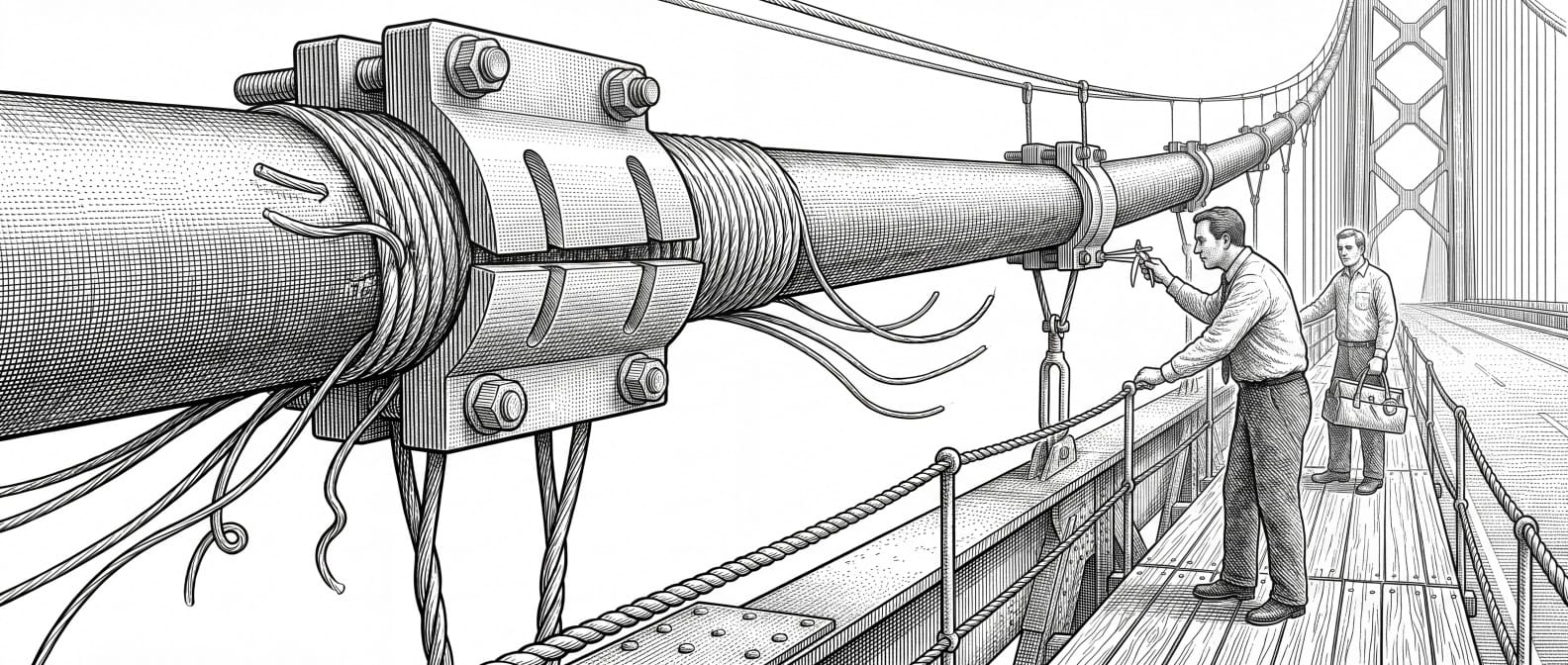
Four things decided this, and the wind that morning was the least of them. • The ceiling came before the drawing. The state layout stood at $11,000,000. The design that carried the federal grant was the one that answered $7,000,000, and the answer was found by taking depth out of the deck. • Depth was the part removed. A 25-foot stiffening truss became an 8-foot solid girder. Solid, it held the wind instead of letting it through, and at 2,800 feet the depth ratio reached 1 to 350 against 1 to 168 at the Golden Gate. • The board named flexibility, not weather. Ammann, von Karman and Woodruff reported to the Federal Works Agency on March 28, 1941 that the principal cause was excessive flexibility, and that the solid girder and deck together worked as an aerofoil. • One band held the whole geometry. At mid-span the clamping band on the north cable slipped, splitting that cable into two unequal lengths. More than 350 wires broke there, and the motion turned from vertical to twisting within minutes. |
WHO PAID |
|
The structure came to $6,400,000, of which the two piers took $2,401,726. In March 1941 Washington put its figure at $5,200,000; in June the twenty-two companies carrying the policies came back with $1,800,000; in August the two sides settled at $4,000,000. Then the arithmetic ran the other way. Clearing the steel out of the Narrows took twenty-nine months. The Toll Bridge Authority put out $646,661 for the operation and took back $295,726 for 7,000 tons of scrap, a net figure against it of $350,933. The travelling public waited longest. Two ferries were back on the route by six the next morning and stayed there for ten years. The replacement opened in October 1950 and stood, as of June 1952, at $14,011,384.28. |
THE PATTERN |
|
• A number set before the drawing. When the figure comes first and the drawing is fitted to it, what goes is depth, which does nothing until it is needed. • A reviewer who cannot stop it. The PWA engineer declined to recommend acceptance in July 1940. The bridge was accepted, and he was relieved on January 25, 1941. • Motion described as character. The deck moved from the week the steel floor closed in May 1940. A nickname and four hydraulic jacks followed, neither of them a design question. • The study that begins after opening. By September 1940 the state was testing a model of something already carrying cars, with the wind deflector contract still in draft. I watched a Chicago clearing firm cut its overnight cushion in the late 1980s, and nobody pointed at that cushion until the morning it was wanted. Before the next thing is trimmed to fit a number, ask which part exists only for the worst day - the girder depth, the ounce of gold that sits still for years and is meant to. |