▫️ Someone Can Legally Drill Your Land. You Get a Letter First.
A 1993 amendment requires notification before entry and gives the landowner no power to refuse.

▫️ THE CORE TOPIC
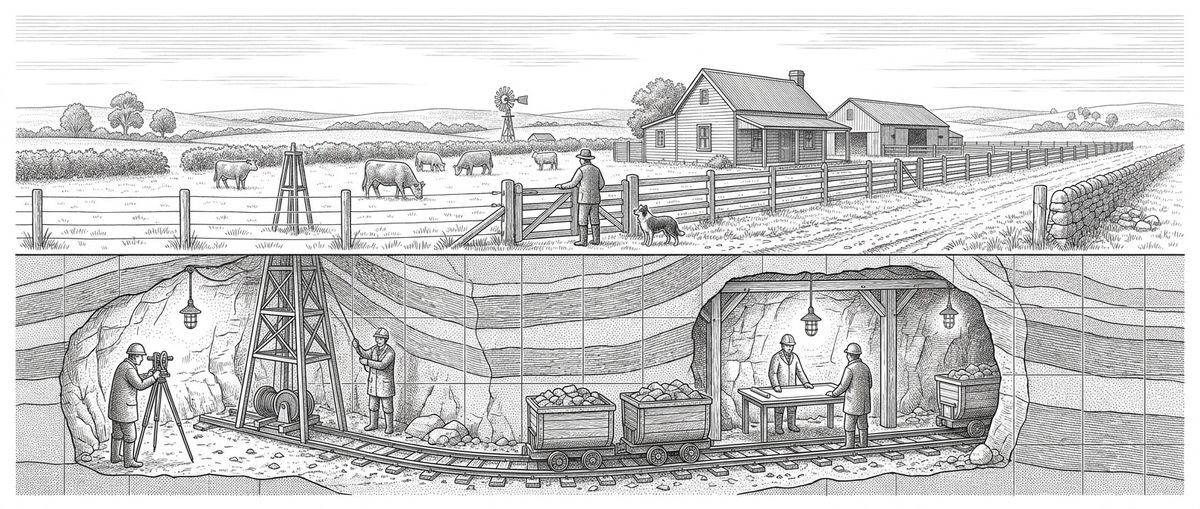
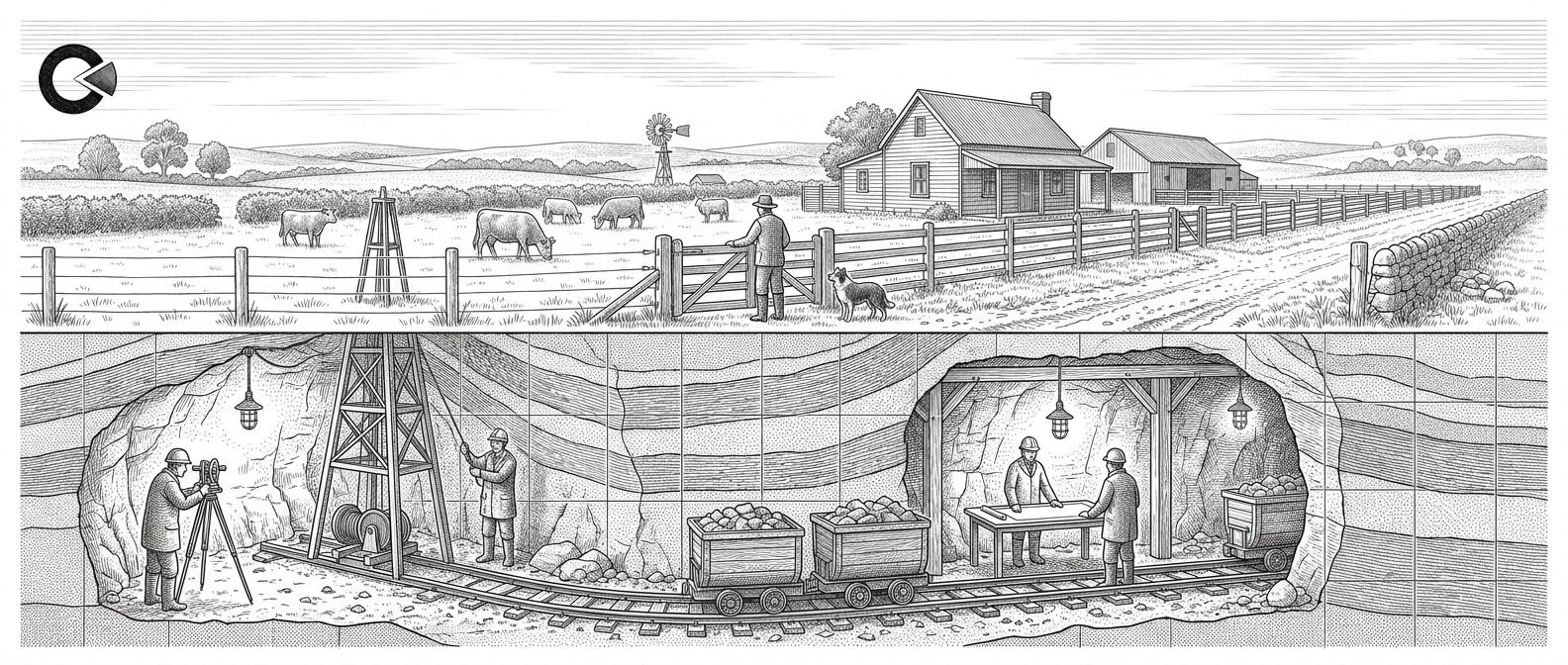
Most people assume that owning land means owning it downward. Buy the field and you have bought what sits under it. In American law that is not a requirement, only a common outcome.
Property here can be severed into a surface estate and a mineral estate, held by different owners, sold at different times, to different people. The federal government is one of the largest holders on the lower side: the Bureau of Land Management manages one in every 10 acres of land in the United States and roughly 30 percent of the nation's minerals.
What makes the arrangement consequential is that the lower estate is generally the dominant one. Whoever owns what lies beneath holds a right of reasonable access to reach it, which means crossing ground that somebody else believes is entirely his.
It is also why the worth of some very old landholding companies sits in what their ground carries rather than in anything standing on top of it. The building is visible. The estate underneath it is the asset.
▫️ THE MECHANISM
A severance works through four features, and all of them outlive the people who created them.
- The split happens once and lasts. A severance made a century ago runs with the land permanently. Nothing about walking the field reveals it, and the current owners on both sides usually inherited the arrangement.
- The lower estate is dominant. The mineral owner holds a right of reasonable access, so the surface owner cannot simply refuse entry to his own property.
- A patent can reserve rather than convey. Land can be handed over with a carve-out written into the grant, and the carve-out is permanent while the ownership above it turns over many times.
- Notice is not consent. Where notification rules exist they oblige somebody to tell the surface owner what is coming, and they stop there.
Most of the world avoids the argument altogether. The state owns everything below the surface outright, which is why control of ground so often turns out to be a political question rather than a property one.
▫️ THE CASE FILE
The largest deliberate severance in American history was an act of Congress. The Stock Raising Homestead Act of 1916 let a settler claim 640 acres of non-irrigable land designated for stock raising. Mineral exploration was accelerating, and the federal government kept the mineral rights to everything patented under the law.
The settler received the surface. The United States kept what lay underneath, and the landowner still has no right to sell it.
The consequence still runs. Those lands remain open to mineral entry even though the surface is private, and a 1993 amendment required that the surface owner be notified before entry without giving him power to prevent it. A decision taken in 1916 still governs who may walk onto a ranch in 2026.
▫️ THE PRESSURE TEST
- The severance is discoverable. Title work shows it plainly. The difficulty is that buyers rarely commission it for ground they assume is simple.
- The dominant estate carries duties. Access has to be reasonable, damage to the surface is compensable, and the owner above is not without remedy.
- It works in the other direction too. Owning the mineral estate under someone else's field is a genuine holding that produces income with no building to maintain.
- Most acreage never sees a rig. The right exists on paper across far more land than will ever be drilled or mined, so the practical risk is smaller than the legal one.
The holding with none of this attached is the plainest. Metal already out of the ground has no estate above it, no dominant party with a right of access, and no grant from 1916 buried in the chain of title.
▫️ AUTHOR'S LENS
I learned this from a document rather than a lecture. A friend bought acreage in the West and found out at closing that the ground he had walked belonged to him only from the topsoil up.Nothing was hidden and nothing was illegal. He had assumed a boundary drawn on a map went down as well as sideways. Since then I read what is being conveyed before I read the price, and the part of my capital that needs no chain of title sits at the base.Build the structure. Ignore the noise. |  |
▫️ PAST ISSUES