Salmonella in Georgia peanut paste reached 714 people across forty-six states.

 |  | Susan Price & Marcus Grant October 5, 2026 |
THE SHORT VERSION |
• A Georgia plant ground peanuts into paste and butter. • Twelve lots tested positive, were retested, and went out. • The paste line ran for fifteen weeks uncleaned. • The plant closed in February 2009 and never reopened. |
THE SETUP |
Peanut Corporation of America ran a processing plant in Blakely, Georgia. It made nothing a shopper would recognise. It roasted peanuts and ground them into paste, butter, meal and chopped granules, then shipped the material to companies that put it inside crackers, cookies, ice cream and institutional kitchens. That position mattered more than the size of the firm. One lot of paste left Blakely and entered other companies' products under other companies' names, so the plant's name appeared on no shelf anywhere. 714 people in 46 states were eventually counted, with onsets running from 1 September 2008 to 31 March 2009. The plant tested its product. That is the part to sit with. Finished lots went to an outside laboratory and the results came back in writing. A plant that tests for the organism looks like a plant in control of it, and the inspection record shows the testing was real. What the record also shows is what happened next, twelve times. |
THE TIMELINE |
Every row below comes from one document: the inspection report the Food and Drug Administration issued to the plant operations manager on 27 January 2009, at the close of an inspection that had run since the ninth of that month. It is a Form 483, the written list of what an investigator observed on site. Observation 1 names twelve lots. Read the last row first. On 26 September 2008 the plant made a lot of peanut paste, number 8278. It returned a positive result for Salmonella Typhimurium. It was tested again, came back negative, and went into interstate commerce. The line that made it was not cleaned afterwards, and it kept running until 9 January 2009. |
THE BREAK |
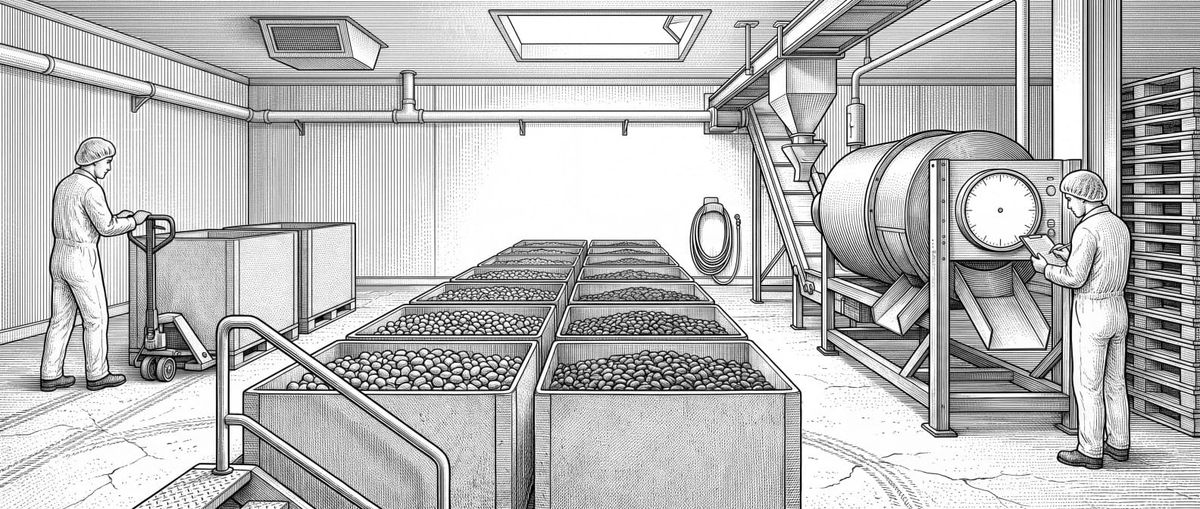
Four things on the inspection record carried the weight, and the first positive result is not one of them. • The retest outranked the test. Twelve lots came back positive from the laboratory, were tested a second time, came back negative, and were released. The report records no step between the two tests that would change the lot. • The kill step was never measured. The plant treated roasting as the stage that removes the organism, and had never established that the temperature, the volume or the belt speed were adequate to do it. The final roller at the roaster discharge was sleeved in felt, which cannot be cleaned. • The cluster took weeks to see. The national laboratory network matched 13 isolates on 10 November 2008, and the field investigation opened on 25 November with 35. The median gap between falling ill and the isolate reaching the network was 16 days. • Raw and finished stood together. Totes of unroasted peanuts sat beside totes of finished product. Swabs taken within fifteen feet and within three feet of finished product returned Salmonella Senftenberg and Salmonella Mbandaka. |

WHO PAID |
714 people in 46 states, by the final count. Nine died: one in Idaho, three in Minnesota, one in North Carolina, two in Ohio and two in Virginia. The median age was 16. One in five was under five years old, and 24 per cent went to hospital. Former officers of the firm and a broker were tried together in Albany, Georgia. A jury returned its verdicts on 19 September 2014, at the end of a seven-week hearing that took in 45 witnesses and 1,001 documents. The health agency's own projection, cited when those verdicts were announced, is more than 22,000 cases in all. The 714 are the ones with a laboratory match behind them. The rest are an estimate, and the estimate is the agency's own. |
THE PATTERN |
• A retest is a decision, not a measurement. When an answer is checked again and the second one travels, ask what changed between them. Usually nothing did. • Find the step everybody assumes. Every process has one stage treated as the thing that makes the rest safe. Ask who measured it, when, and against what. • The record and the thing are not the same. A file of results describes a lot. Gold is the other case: what the paper says and what sits on the scale are one object. • Look at what stands next to what. Three feet between raw material and finished product is a layout decision, visible from the doorway. I stood on a floor in 1989 where a quote that looked wrong was simply asked again, and the second answer was the one that printed. Take any process that ends in a yes or a no, and ask how many times it may be run before the answer counts. |