▫️ Every Industry Gets Cheaper With Scale. Mining Does the Opposite.
Theodore Wright measured the same effect in aircraft in 1936, and it still describes new technologies.

▫️ THE CORE TOPIC
Most people assume things get cheaper as years pass. Technology improves, prices come down, the calendar does the work. That is not what the evidence shows.
Cost falls with repetitions. An aerospace engineer named Theodore Wright measured it in aircraft production in 1936 and found that unit cost fell by a consistent percentage every time cumulative output doubled. The same shape keeps reappearing. For more than four decades the price of solar panels declined by 20% with each doubling of global cumulative capacity.
The variable is not the year. It is the number of times the work has been done. A technology nobody is building stops getting cheaper no matter how modern it is, and one being built at scale keeps improving even when it looks mature.
That distinction separates the businesses that compounded for decades from the ones that simply had a good product. The winners were the ones whose cost per unit kept falling while their volume kept rising.
▫️ THE MECHANISM
The curve is built out of four things happening in sequence.
- The clock is not the variable. Cost tracks cumulative units produced, not years elapsed. Two decades of low volume move it less than one year of high volume.
- Labour learns first. The same crew doing the same task for the hundredth time is faster than it was on the tenth, and the gain arrives without anyone deciding anything.
- Then the process gets redesigned. Jigs, tooling, prefabrication and standard parts only make sense once the volume justifies building them, and each one resets the baseline.
- Then the inputs get cheaper. Suppliers are riding their own curves on the same rising volume, so the saving compounds down the chain.
The visible sign is output per person climbing while the product itself gets cheaper. When a business shows both at once, that is the curve appearing in the accounts.
▫️ THE CASE FILE
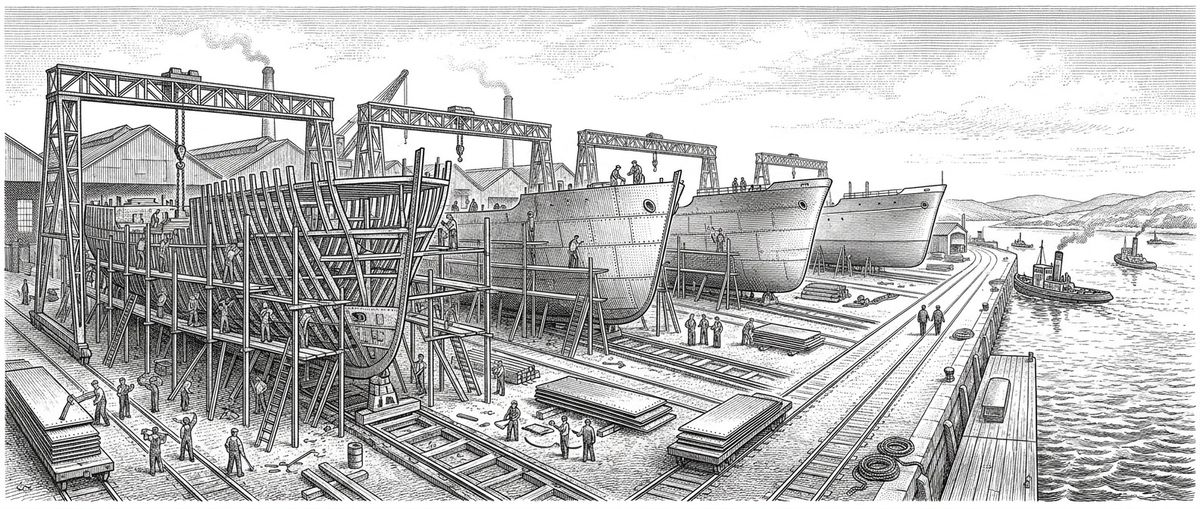
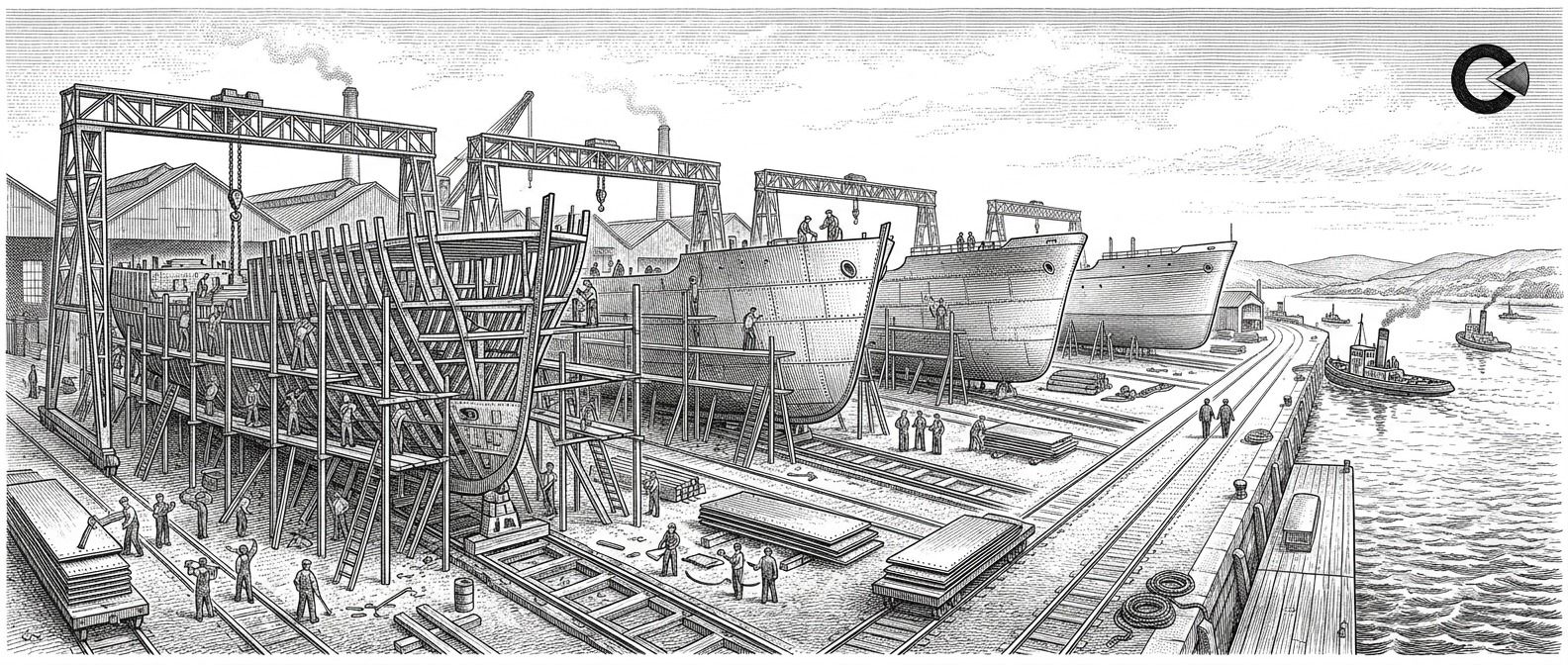
The most compressed example on record is American shipbuilding in the Second World War. Eighteen yards eventually completed 2,710 Liberty ships, all to one standard design, and the early ones took an average construction period of 70 days. By 1944 the average was 42.
The demonstration came in November 1942. The keel of the SS Robert E. Peary was laid at one minute past midnight, and 250,000 parts weighing about 14,000,000 pounds were assembled in 4 days, 15 hours and 29 minutes. She was launched on 12 November.
That was a publicity run rather than normal practice, and much of the fitting out still followed. The ordinary number is the one that matters. Same design, same steel, same men, and 28 fewer days.
▫️ THE PRESSURE TEST
- The curve needs volume, not intention. No doubling means no decline. A promising technology built in small numbers stays expensive for as long as that lasts.
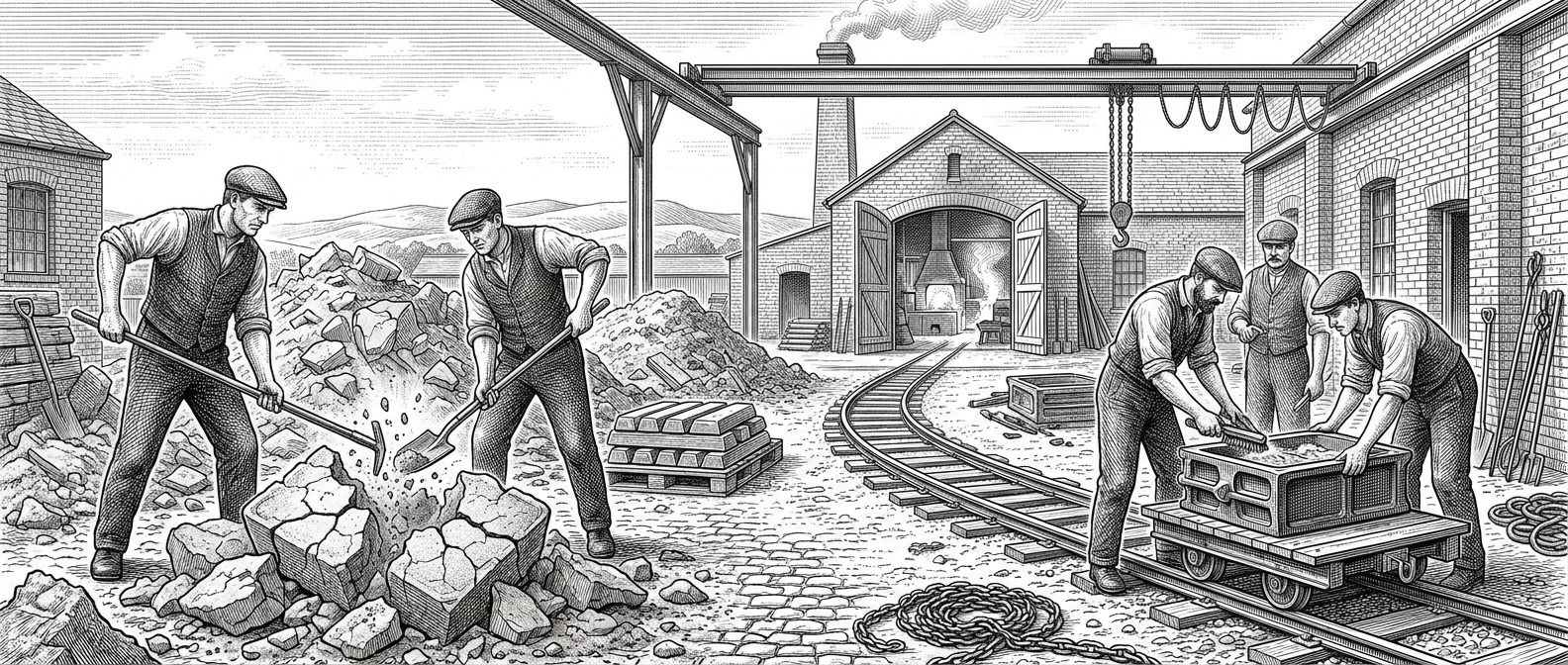
- It describes manufacturing, not extraction. The best ore is taken first, so grades fall as a deposit is worked and the cost of the next tonne climbs rather than drops.
- Cheaper does not mean more profitable. When every competitor sits on the same curve, the saving reaches the customer instead of the owner.
- The rate is measured, not guaranteed. Learning rates are fitted to history after the fact, and a curve can flatten when a physical limit arrives.
Which is exactly why the metal at the centre behaves differently. Nobody has ever found a learning curve for producing more gold, and that absence is the reason an ounce keeps its standing while manufactured things get cheaper around it.
▫️ AUTHOR'S LENS
I spent the early part of my career assuming price declines were a matter of time passing. They are a matter of somebody doing the work again, and again, and then ten thousand more times.So when I look at a business now, I count repetitions rather than years. And when I look at what I hold at the base of my capital, the appeal is the opposite property. No amount of practice makes another ounce.Build the structure. Ignore the noise. |  |
▫️ PAST ISSUES