▫️ Data Centres Drank 17.4 Billion Gallons in One Year. Nobody Priced It.
Projections put direct consumption between 38 and 73 billion gallons by 2028, concentrated in a few dry states.

▫️ THE CORE TOPIC
Water has been treated as a cost line rather than an asset. It arrives through a pipe, the bill is small next to everything else, and almost nobody models it.
That is changing where the computing is going. American data centres directly consumed 17.4 billion gallons of water in 2023, and projections put direct consumption between 38 and 73 billion gallons by 2028. A single large site can withdraw several million gallons a day.
Water differs from every other input in one way. There is no substitute for it. Fuel can be switched, chips replaced, labour relocated. Nothing else fills a cooling tower, and unlike electricity, water cannot be shipped any distance economically. It is priced locally, allocated legally, and fixed in place.
Which is why attention has moved to whoever holds the land, the power and the water in the places these facilities want to be built. Owning the ground beneath an industry is a different business from operating inside it.
▫️ THE MECHANISM
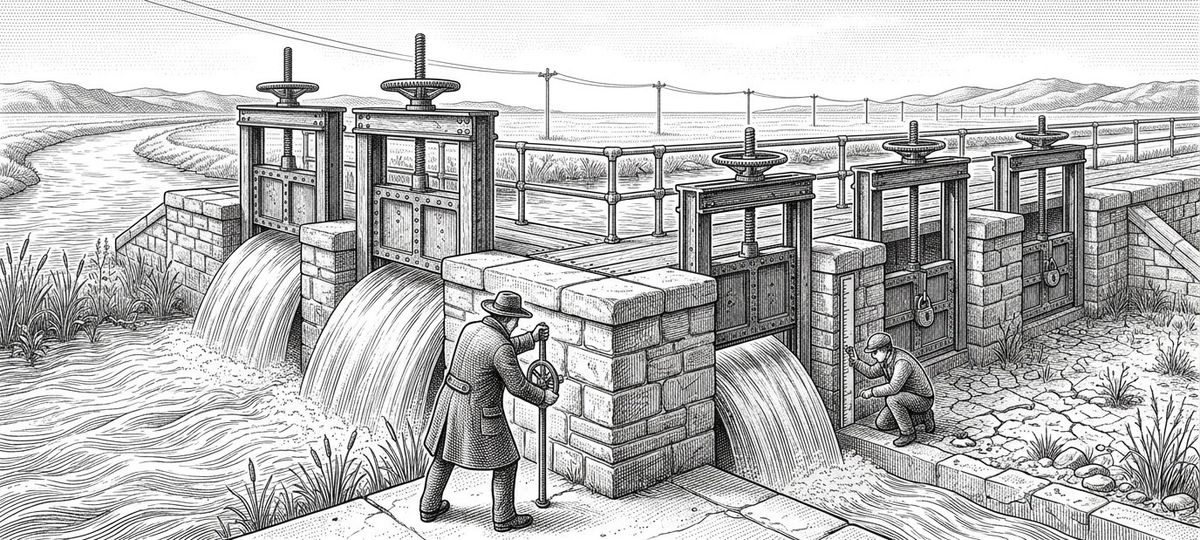
A water right is a legal instrument, and it behaves like one.
- Seniority decides who gets cut. Across the American West, rights are ranked by the date they were first claimed. In a shortage the newest right goes to zero before the oldest loses a drop.
- The reductions are written years ahead. Under current Colorado River rules the level of Lake Mead triggers fixed cuts, calling for Arizona to contribute 512,000 acre-feet, about 18 percent of its annual apportionment.
- Consumption is not withdrawal. Up to 85 percent of what an evaporative cooling tower takes never returns to the system, so the number that matters is what leaves, not what is drawn.
- The right can be separated from the land. In many states water is sold apart from the acreage, which turns it from a utility line into an asset with its own market.
Every one of those rules is written in acre-feet. Discussion about the dollar's future changes the number on the deed. It does not change the volume behind it.
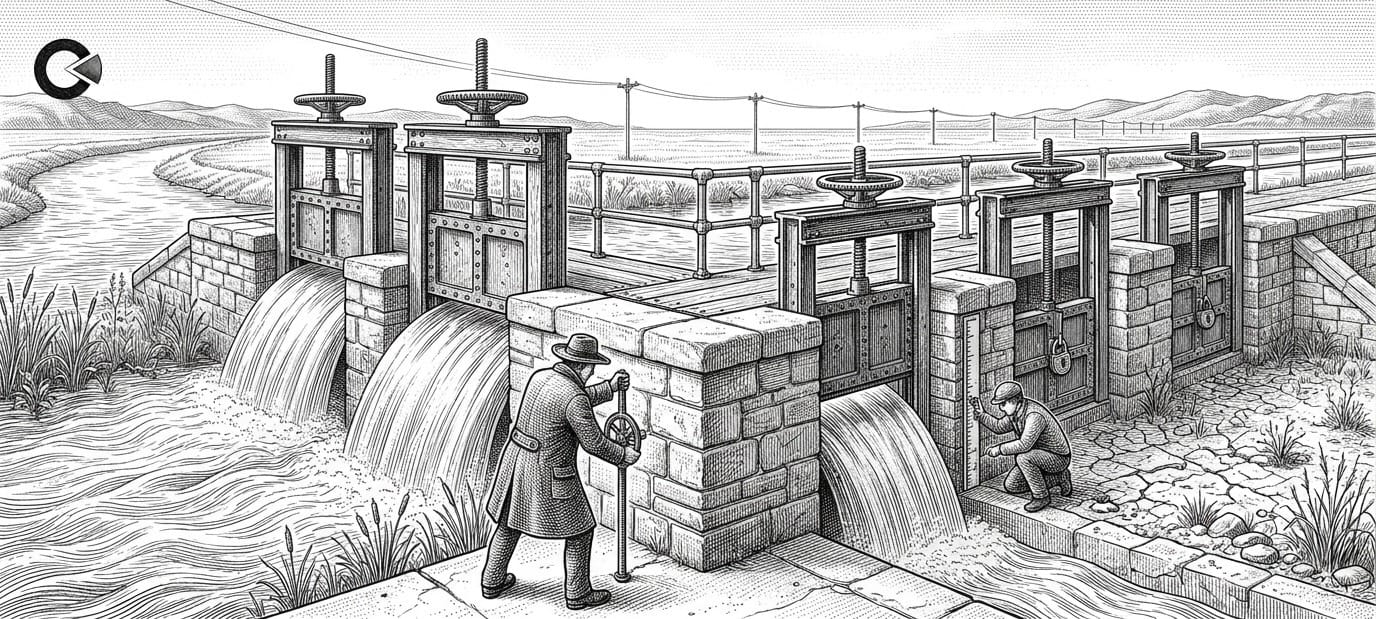
▫️ THE CASE FILE
America has already run the experiment of dividing water on paper. The Colorado River Compact of 1922 split the river between an Upper and a Lower Basin, guaranteeing each of them 7.5 million acre-feet a year in perpetuity.
The whole arithmetic rested on one measurement. The negotiators worked from an assumed average of about 18 million acre-feet a year, drawn from a stretch of years that turned out to be unusually wet. The river has not delivered that since.
The claims were never cut back to match. The system has been run by exception instead: reservoir tiers, contribution schedules, and interim agreements that expire at the end of 2026. The paper was not wrong about the law. It was wrong about the water.
▫️ THE PRESSURE TEST
- Water is not scarce everywhere. Much of the country has plenty, and a right in a wet basin trades at a fraction of the same paper in a dry state.
- Technology moves the number. Closed-loop and air cooling cut water use sharply at the cost of more electricity, and those designs are changing fast.
- Allocation is political. Rights are set by state law, courts and interstate compacts, and the rules can be rewritten by people who hold none of them.
- A deed is not a cash flow. Many rights carry beneficial-use conditions and transfer limits, so owning one and selling from it are separate questions.
The principle is the one that governs metal. Value sits with the physical thing, in a place where it is genuinely scarce, and a claim written on paper is worth exactly the volume standing behind it.
▫️ AUTHOR'S LENS
I have watched companies model every input except the one they assumed would always arrive. Energy got a full page in the deck. Water got a footnote and a municipal contract signed years earlier.The question I ask now about any long-lived facility is short. Who holds the senior right, and what does this business look like in the first year it is not honoured. Nobody sells a substitute for water, which is why the right to it is worth reading closely.Build the structure. Ignore the noise. |  |
▫️ PAST ISSUES