▫️ China Controls 94% of the Magnets Inside Every Weapon You Fund
A one-year truce on export controls expires in November 2026. What happens to supply chains then is the real question.
▫️ THE CORE TOPIC
For decades, raw materials were treated as commodities. You bought them on the open market at the going price. Supply was assumed. The only question was cost.
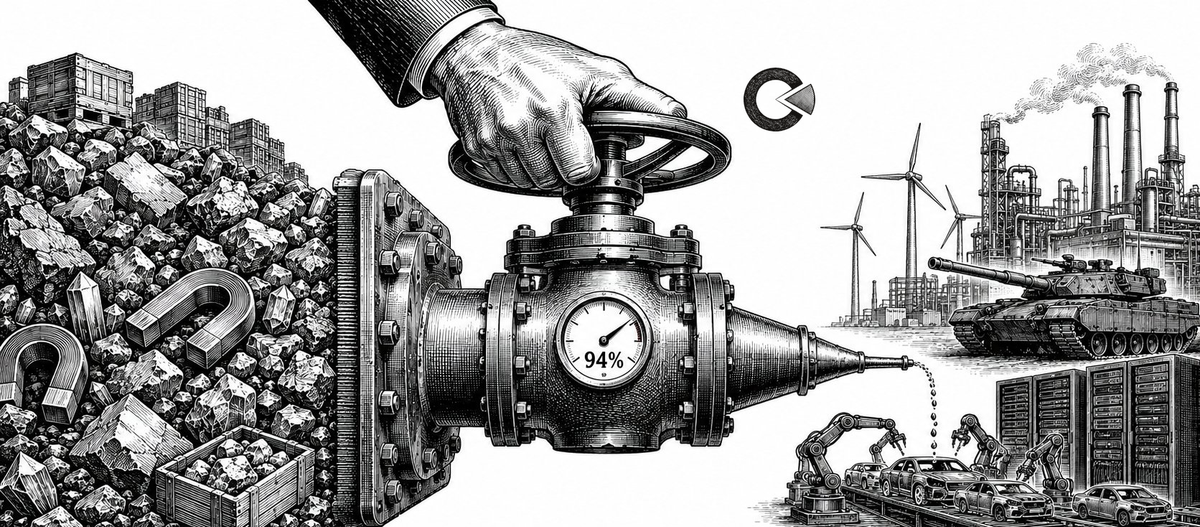
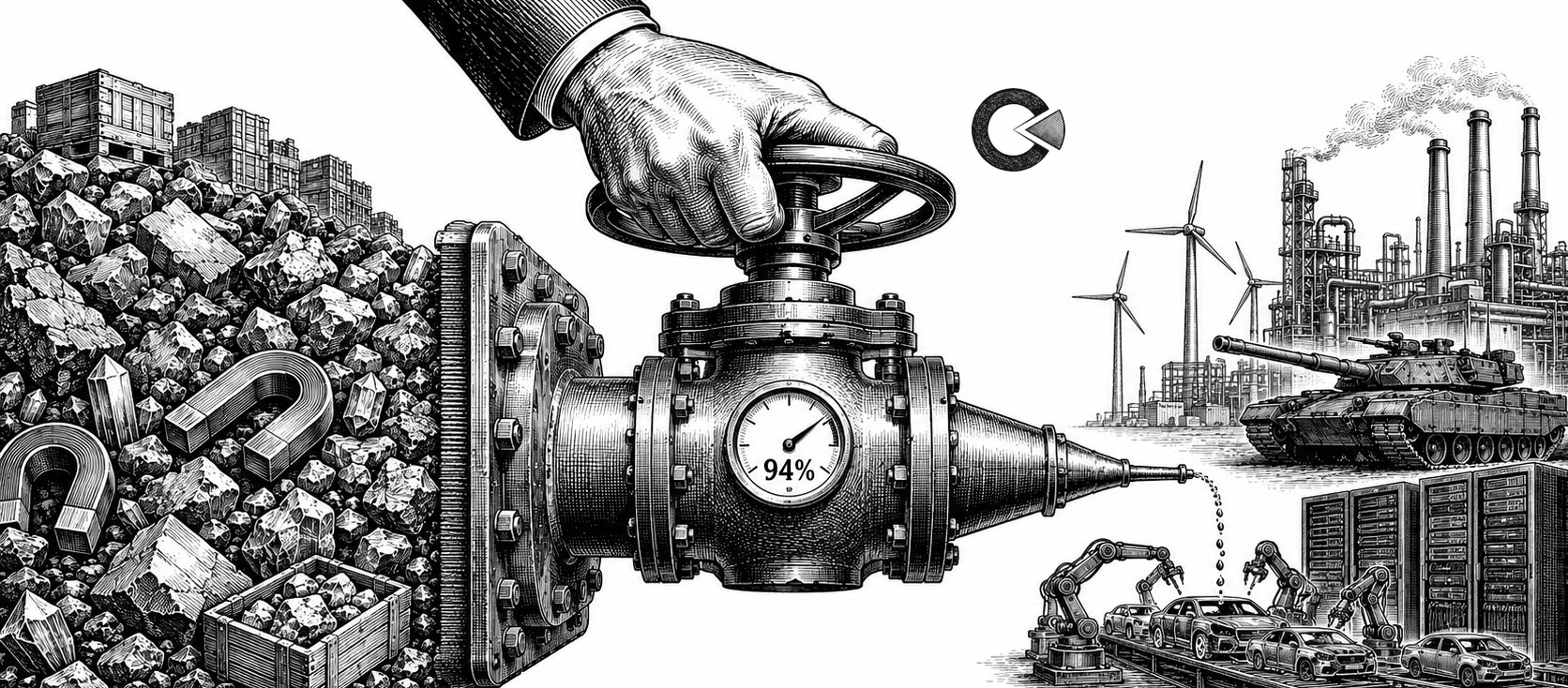
That assumption is breaking. China now refines roughly 70% of nineteen of the twenty most strategic minerals, and produces 94% of the world's sintered permanent magnets, the components inside every electric motor, missile guidance system, wind turbine, and AI data center. In October 2025, Beijing imposed licensing controls on any product containing even 0.1% Chinese-origin rare earths. The rules were suspended for one year after the Trump-Xi summit, expiring November 2026.
The structural driver is processing concentration, not geology. Rare earths are not rare. This is why small mining stocks now swing 200% to 500% on the resource story, and why supply-chain control has become a geopolitical weapon.
▫️ THE MECHANISM
Control of a critical material does not require owning every mine. It requires owning the choke point. Four gears drive the leverage.
- Processing is the bottleneck. The ore exists in many countries. The refining capacity sits in one. China built 70% of global processing over two decades.
- Licenses are the lever. Beijing does not ban exports outright. It requires a license, then calibrates approvals country by country, firm by firm.
- Magnets concentrate the risk. China's share of permanent magnet production rose from 50% two decades ago to 94% today. Defense and autos cannot substitute quickly.
- Speculation follows scarcity. Each new control sends junior miners surging on the next-wave resource story, regardless of production timelines.
The country that controls refining holds the tap, whatever the ground holds.
▫️ THE CASE FILE
Consider September 2010. A Chinese trawler collided with Japanese Coast Guard vessels near the disputed Senkaku Islands. Japan arrested the captain. Within days, Chinese customs halted rare earth shipments to Japan, which then depended on China for nearly 90% of its supply.
The embargo lasted roughly two months. Combined with pre-existing quota cuts, global rare earth prices soared tenfold in the year that followed. Japanese industry, especially automakers reliant on magnets, went into panic.
Japan responded with a decade of diversification: funding Lynas in Australia, building stockpiles, cutting Chinese dependence from 90% toward 60%. Concentration is leverage until broken.
▫️ THE PRESSURE TEST
The critical-minerals story is real. The risks of acting on it are also real.
- Most junior miners never produce. A deposit is not a mine. Permitting, processing, and financing kill the majority before output.
- Speculative gains reverse fast. Stocks that run 300% on a licensing headline give it back when the truce holds.
- Processing takes a decade. Even funded Western projects need years to reach scale. The bottleneck does not clear on a news cycle.
- Substitution and recycling advance. Engineers design around scarce elements, softening demand over time.
These risks are real. But investors who understand where the true choke points sit have positioned ahead of the crowd that reacts only when the next export license makes headlines.
▫️ AUTHOR'S LENS
I have watched commodities get treated as afterthoughts my whole career. Cheap, abundant, always there. Then one government closes one valve and the whole assumption collapses.I do not chase the junior miner that doubled last week. I study who controls the processing, because that is where the real leverage lives. The ground is not the choke point. The refinery is.Build the structure. Ignore the noise. |  |
▫️ PAST ISSUES