A whole South Carolina town was evacuated because of one hand lever.

 |  | Susan Price & Marcus Grant October 7, 2026 |
THE SHORT VERSION |
• A local crew left a track switch turned over. • Nobody checked it for seven and a half hours. • A freight train took the siding at 47 mph. • Nine people died in a South Carolina town. |
THE SETUP |
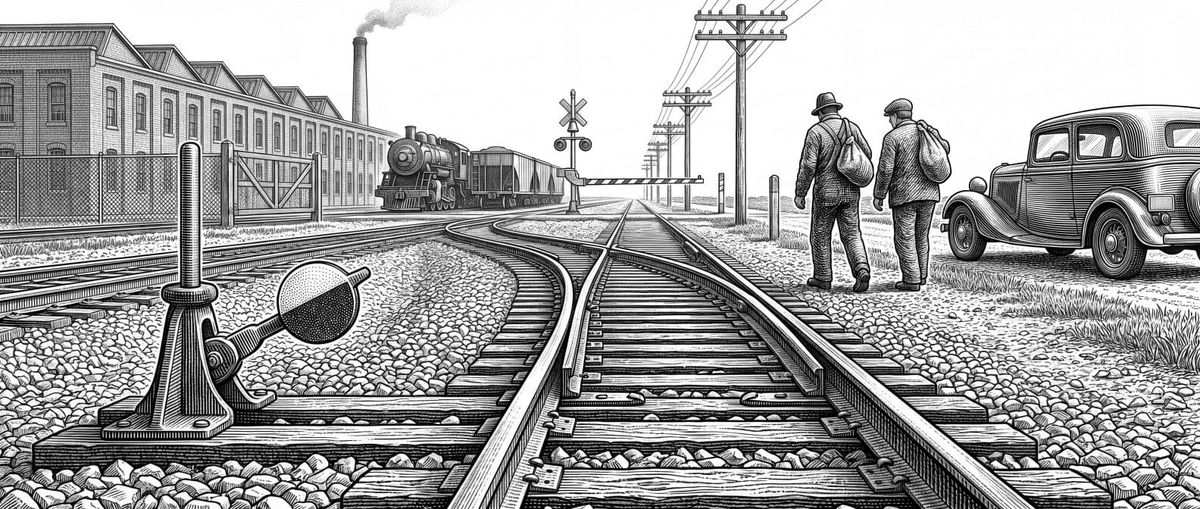
Graniteville sits in a shallow valley in Aiken County, South Carolina, with a single track running north and south through the middle of it and a textile mill along the west side. The line is not signalled. A dispatcher in Greenville gives each train written authority for a stretch of track, and the switches are thrown by hand. On the evening of 5 January 2005 a local crew of three took two cars of caustic soda into the mill. To get in, they threw the main line switch over to the siding. They had been on duty since seven that morning, their twelve-hour ceiling fell at seven that evening, and a taxi was already waiting for them. Seven and a half hours later a through freight came up the line at 47 mph. Nine people died and 529 went looking for medical care. The switch had not moved. It was still lined and locked for the siding, and the train did what the rails told it to do. |
THE TIMELINE |
Every row below comes from one document: the accident report the National Transportation Safety Board adopted on 29 November 2005. Most of the times in it are read off locomotive recorders rather than off anybody's memory, which is why the clock in this issue runs to the second. Read the row at 6:52 p.m. The recorder on the parked locomotive shows the throttle at idle, the brake applied and the speed at zero, and after that no control was touched again. The work was over. Everything still outstanding at that point had to be done on foot, in the dark, by three men with a taxi waiting. The taxi was already parked on the grass beside the locomotive. |
THE BREAK |
Four things sat behind this, and none of them is that somebody forgot. • The last task had nothing attached to it. The board put it plainly: there was no feature or mechanism that would have reminded the crew of the switch position before they left. Every other step that evening ended in a coupling, a gate or a radio call. This one ended in nothing. • Three men were placed to see it. The rule said the switch belongs to whoever handled it, and that this does not relieve the others if they are placed to observe. The siding curved, so the banner never came into the headlight. • The paperwork had a gate and it stood open. Clearing a track warrant required the switch to be locked normal first. The warrants were cleared at 7:53 p.m. Two other railroads had added a spoken check at that step three months earlier. • The advisory came five days later. The regulator wrote to every railroad on 11 January 2005, asking them to write down when a hand switch is thrown and when it is put back, and to tell the dispatcher. |

WHO PAID |
Nine died: eight where they stood and one in hospital. Six worked at the mill, one drove a truck at one of the plants, one was at home south of the site, and one was the engineer of the train that came up the line. About 180 people were on the night shift inside the mill. A follow-up five months on reached 94 of the people interviewed in the first days. Seventy-six still had symptoms they put down to the chlorine, 47 were still under a doctor and 49 were still taking medicine. Forty-four of 92 screened positive for post-traumatic stress. The town itself was emptied. Everyone inside a mile, 5,453 people, was moved out, and the last of them did not get home for thirteen days. |
THE PATTERN |
• Find the step with nothing after it. Every task that ends in a signal, a receipt or a reply gets checked by somebody. The one that ends in walking away does not. • A shared duty is nobody's duty. Three men could have looked, and the rule said so. All three remembered the job as finished. • Nothing here confirmed itself. The switch did not report its own position, and the paper that should have asked about it was signed instead. Gold is the other arrangement: the weight on the scale is the confirmation, and it waits on nobody. • Time pressure moves the mistake, not the work. The crew was inside its twelve hours. What the pressure took out was the briefing at the start and the look back at the end. I worked a desk in 1994 where the end-of-day position was agreed out loud by two people, and that rule existed because once it had not been. Take any job that ends with somebody going home, and ask what, other than their memory, records that the last step was done. |